



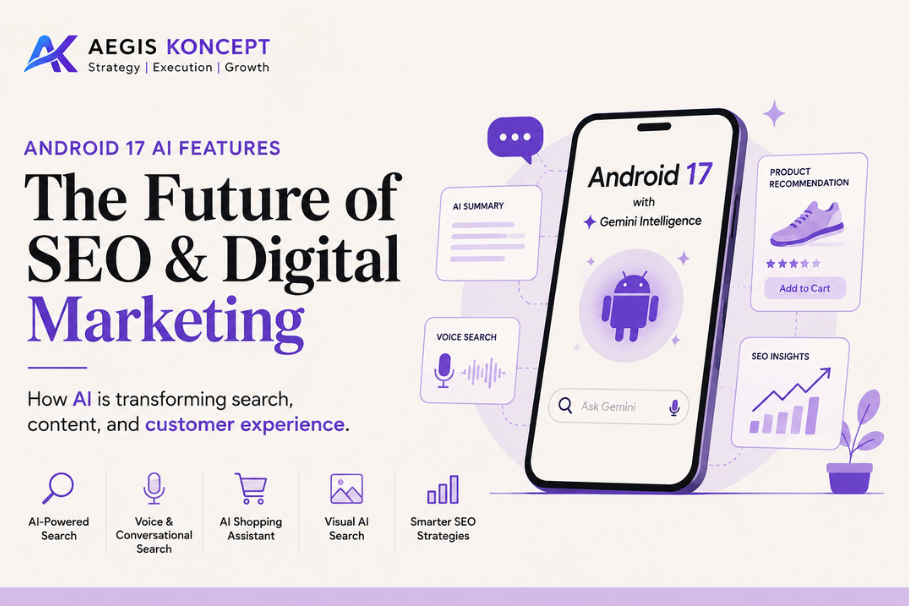
Android 17 is not just another Android update. Google is turning Android into a full AI-powered ecosystem with Gemini Intelligence at the center. From AI-generated summaries and smart shopping assistance to voice-powered search and automated tasks, Android 17 is changing how users discover content, interact with brands, and make buying decisions.
For digital marketers, SEO experts, ecommerce brands, and content creators, this update is a massive shift. Traditional SEO strategies focused only on rankings may no longer be enough because AI can now recommend products, summarize websites, and even complete actions without users visiting multiple pages.
This means businesses must start optimizing not only for Google Search, but also for AI-driven experiences, conversational search, visual discovery, and Generative Engine Optimization (GEO).
In this blog, we’ll break down the most important Android 17 AI features and explain how they will impact SEO, digital marketing, ecommerce, local SEO, and the future of online visibility.
What Is Android 17 Gemini Intelligence?
Google introduced Gemini Intelligence as the core AI system powering Android 17. Instead of users manually switching between apps, searching multiple websites, or typing long queries, Gemini can now understand context, analyze screens, and complete tasks automatically.
For example, a user can ask Gemini to:
- compare products
- summarize a webpage
- book appointments
- create shopping carts
- reply to messages
- search based on screenshots or images
This changes how people interact with the internet completely.
Earlier, users used Google Search to find answers manually. Now Android 17 is moving toward an AI-first experience where Gemini may directly recommend the best result instead of showing users multiple options.
For SEO and digital marketing, this is huge.
Brands will now need:
- stronger authority
- better content quality
- structured data
- conversational content
- trust signals
- optimized product information
because AI systems will choose which businesses deserve visibility.
This is why concepts like GEO (Generative Engine Optimization), Entity SEO, and conversational search optimization are becoming more important than traditional keyword stuffing or basic ranking tactics.
Major Android 17 AI Features That Will Impact SEO & Digital Marketing
Android 17 introduces several AI-powered features that can completely change how users search, shop, and interact with brands online. These features are not just upgrades for Android users — they directly affect SEO, ecommerce, content marketing, and lead generation.
AI-Powered Chrome Summaries
Gemini can now summarize webpages directly inside Chrome. Instead of reading full blogs, users may get instant AI-generated answers and comparisons.
This means low-quality and generic content may lose traffic because AI will prioritize pages with:
- original insights
- expert information
- real examples
- trustworthy data
- strong authority
For SEO, content quality now matters more than ever.
Visual AI Search
Android 17 can understand screenshots, photos, and on-screen content. Users can search products directly from images and get recommendations instantly.
This makes:
- image SEO
- alt text optimization
- product image quality
- visual branding
much more important for ecommerce websites and businesses.
Voice & Conversational Search
With smarter voice AI, users are searching more naturally instead of typing robotic keywords.
For example:
Instead of searching:
“best seo course delhi”
Users may say:
“Which is the best practical SEO course near me with live projects?”
This is why conversational SEO and long-tail keyword optimization are becoming essential.
AI Shopping Assistance
Gemini can compare products, suggest the best option, and even build shopping carts automatically.
For ecommerce brands, this means product pages need:
- clear descriptions
- reviews
- FAQ schema
- pricing transparency
- trust signals
- detailed product information
because AI systems will use this information while recommending products.
Multi-Step AI Actions
Android 17 AI can perform tasks across apps automatically, like booking services, filling forms, or ordering products.
This reduces the number of steps users take manually and changes how conversion funnels work.
Businesses now need websites that are:
- AI-readable
- fast
- structured
- schema optimized
- mobile friendly
to stay visible in AI-powered experiences.
How Android 17 Will Change SEO
Android 17 is pushing SEO into a completely new phase where ranking on Google alone is no longer enough. As Gemini AI becomes deeply integrated into Android, search behavior is becoming more conversational, visual, and AI-driven.
Earlier, users searched, opened multiple websites, compared information, and then made decisions manually. Now AI can summarize results, recommend brands, and complete actions instantly.
This changes the entire SEO game.
GEO (Generative Engine Optimization) Will Rise
Traditional SEO focused on getting clicks from search engines. GEO focuses on becoming the source AI trusts and recommends.
If Gemini cannot understand or trust your content, your visibility may drop even if your rankings are good.
That’s why websites now need:
- topical authority
- factual accuracy
- strong branding
- expert-driven content
- structured data
Conversational SEO Will Become Critical
Android 17 is heavily pushing voice and natural-language interactions.
People are now searching using complete questions like:
- “Which is the best anti-aging serum for dry skin?”
- “Find me an affordable SEO course near me.”
Your content should match real human conversations instead of robotic keyword placement.
This means:
- question-based headings
- FAQ sections
- semantic SEO
- natural language optimization
will become essential.
Entity SEO Will Matter More
Google and Gemini AI are focusing more on entities instead of just keywords.
Entities include:
- brands
- people
- products
- businesses
- services
The stronger your brand presence across the internet, the better AI systems can understand and recommend you.
This is why:
- brand mentions
- reviews
- PR coverage
- social signals
- local citations
are becoming stronger ranking factors.
Schema Markup Will Become a Major SEO Advantage
Structured data helps AI systems understand your website faster.
Websites using proper schema may get better visibility in AI-powered search experiences.
Important schemas include:
- FAQ Schema
- Product Schema
- Review Schema
- Organization Schema
- LocalBusiness Schema
- Service Schema
In the Android 17 era, schema is no longer optional — it’s becoming part of advanced SEO infrastructure.
Impact of Android 17 on Digital Marketing
Android 17 is not only changing SEO — it is transforming the entire digital marketing ecosystem. AI is becoming part of everyday mobile behavior, which means marketers must adapt to how users now consume content, discover brands, and make decisions.
The biggest shift is simple:
AI is reducing the gap between discovery and action.
Users no longer need to spend time researching manually because Gemini can provide recommendations instantly.
Content Marketing Will Change
Generic AI-written blogs and repetitive content may struggle to survive because Android AI systems are designed to prioritize useful, trustworthy, and experience-driven information.
Brands that create:
- original insights
- case studies
- real experiences
- expert opinions
- unique visuals
will have a much higher chance of being recommended by AI systems.
This is why content quality is becoming more important than content quantity.
Social Media Search Will Grow Faster
Android 17 connects deeply with apps like YouTube, Instagram, Maps, and Chrome. This supports the rise of “Search Everywhere Optimization.”
Users are now searching directly on:
- TikTok
- YouTube
- AI assistants
instead of only using Google Search.
For marketers, this means every platform now acts like a search engine.
Short-form videos, creator-led content, and user-generated content (UGC) will continue growing because AI systems understand engagement and trust signals from social platforms.
Local Marketing Will Become More Powerful
Voice-based local searches are increasing rapidly with AI assistants.
Searches like:
- “best cafe near me”
- “top dermatologist open now”
- “SEO agency nearby”
are becoming more common.
Businesses with strong:
- Google Business Profiles
- reviews
- local landing pages
- local schema
- updated business information
will gain a major advantage in AI-driven local search.
Ecommerce Marketing Will Become AI-Driven
Android 17 AI can compare products, recommend items, and assist users during shopping.
This means ecommerce brands must focus heavily on:
- trust building
- reviews
- product SEO
- fast checkout
- detailed product information
- visual optimization
because AI may directly influence buying decisions before users even visit multiple websites.
The future of digital marketing is no longer just about visibility.
It’s about becoming the most trusted answer AI chooses to recommend.
How to Prepare Your Website for the Android 17 AI Era
As Android 17 pushes AI-powered search and automation into mainstream usage, businesses need to upgrade their SEO and digital marketing strategies now. Websites that adapt early will have a major advantage in future AI-driven search ecosystems.
Here are the most important areas to focus on.
Build Topical Authority
Instead of publishing random blogs, focus on becoming deeply authoritative in one niche.
Create connected content around:
- core topics
- subtopics
- FAQs
- comparisons
- guides
- case studies
AI systems trust websites that consistently demonstrate expertise.
Focus on Conversational Content
Users are increasingly searching using natural language and voice commands.
Your content should answer real questions clearly and directly.
Use:
- conversational headings
- question-based keywords
- easy-to-read explanations
- semantic keyword variations
This improves visibility for both voice search and AI-generated search results.
Implement Strong Schema Markup
Structured data helps Gemini and search engines understand your content better.
Priority schema types include:
- FAQ Schema
- Product Schema
- Review Schema
- LocalBusiness Schema
- Organization Schema
- Service Schema
Schema can improve how your content appears in AI-powered results and search features.
Improve Brand Trust Signals
AI systems are more likely to recommend trusted brands.
Focus on building:
- genuine reviews
- brand mentions
- PR coverage
- social proof
- expert content
- customer testimonials
In the AI era, trust is becoming a ranking factor.
Optimize for Visual Search
Android 17 strongly supports image-based discovery and AI visual understanding.
Make sure your website uses:
- high-quality images
- optimized alt tags
- descriptive file names
- infographic content
- product visuals
Visual SEO is becoming more important for ecommerce and content marketing.
Prioritize Mobile Experience
Since Android powers billions of devices worldwide, mobile optimization is critical.
Your website should be:
- fast loading
- mobile friendly
- easy to navigate
- lightweight
- conversion optimized
A poor mobile experience may reduce visibility in AI-driven ecosystems.
Create Content AI Wants to Cite
The future of SEO is not just about rankings. It is about becoming a trusted source that AI systems reference and recommend.
Create content with:
- real-world insights
- statistics
- expert opinions
- unique frameworks
- practical examples
because generic content will struggle to survive in AI-powered search experiences.
Final Thoughts
Android 17 is more than a software update — it represents the beginning of a new AI-first internet experience. With Gemini Intelligence deeply integrated into Android, users will increasingly rely on AI to search, compare, discover, and make decisions faster than ever before.
For SEO professionals, marketers, ecommerce brands, and business owners, this creates both a challenge and a huge opportunity.
Traditional SEO strategies focused only on rankings and keywords are slowly evolving into a broader ecosystem that includes:
- GEO (Generative Engine Optimization)
- conversational SEO
- entity SEO
- visual search optimization
- AI trust signals
- structured data optimization
The brands that win in this new era will not be the ones producing the most content. They will be the ones building the most trust, authority, and value across every digital platform.
Android 17 is clearly showing where the future is heading:
AI-powered discovery, voice search, contextual recommendations, and automated actions.
Businesses that adapt early by creating high-quality content, improving technical SEO, implementing schema markup, and building strong brand authority will have a massive advantage as AI-driven search continues to grow.
The future of digital marketing is no longer just about getting traffic.
It is about becoming the answer AI chooses first.
FAQs About Android 17 AI Features & SEO
Will Android 17 affect SEO?
Yes, Android 17 can significantly impact SEO because Gemini AI changes how users search and interact with content. AI-powered summaries, voice search, and contextual recommendations may reduce traditional clicks and increase the importance of trust, authority, and conversational SEO.
What is Gemini Intelligence in Android 17?
Gemini Intelligence is Google’s AI system integrated into Android 17. It can understand context, summarize webpages, compare products, automate tasks, and assist users across apps using AI-powered interactions.
What is GEO in SEO?
GEO stands for Generative Engine Optimization. It focuses on optimizing content for AI-powered search engines and assistants like Gemini and ChatGPT so they can understand, trust, and recommend your content.
How does Android 17 impact digital marketing?
Android 17 impacts digital marketing through AI-powered search, visual discovery, conversational interactions, smarter ecommerce recommendations, and automated user actions. Marketers must now optimize for AI visibility, not just traditional search rankings.
Will voice search become more important after Android 17?
Yes, Android 17 strongly supports conversational and voice-based interactions. Users are increasingly searching naturally using complete questions, making conversational SEO and long-tail keyword optimization more important.
What type of content will perform better in AI search?
Content with:
- real expertise
- original insights
- strong structure
- schema markup
- statistics
- case studies
- conversational formatting
is more likely to perform well in AI-powered search systems.
Is traditional SEO dead because of AI?
No, traditional SEO is not dead. However, SEO is evolving rapidly. Rankings still matter, but AI visibility, trust signals, topical authority, and structured data are becoming equally important.
How can businesses prepare for Android 17 AI search?
Businesses should focus on:
- conversational SEO
- schema implementation
- topical authority
- brand trust
- mobile optimization
- visual SEO
- high-quality content creation
to stay competitive in AI-driven search experiences.